What to Expect:
The Delaware County Children’s Advocacy Center (DCCAC) is a program of Family Support Line, and it is a place where children who may be victims of child abuse talk with a trained forensic interviewer about their experiences.
The DCCAC is here to make the child abuse investigation process go as smoothly as possible, both for you and your child. Cases are referred to us by local police, Children and Youth Services, or the District Attorney’s Office.
The Delaware County Children’s Advocacy Center (DCCAC) is a program of Family Support Line, and it is a place where children who may be victims of child abuse talk with a trained forensic interviewer about their experiences.
Foundation for a typical interview:
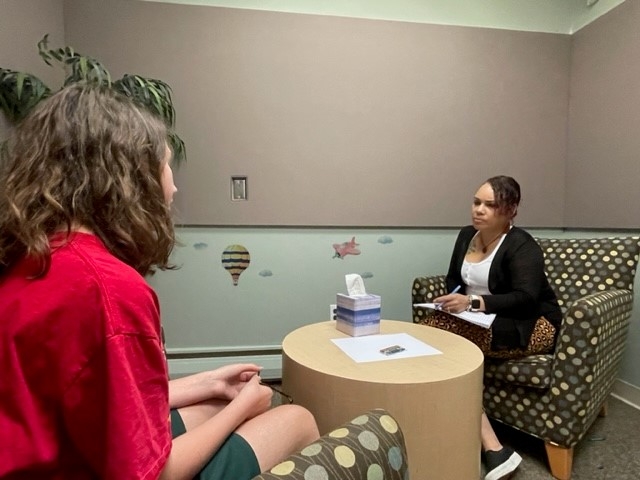
The Forensic Interviewer will meet your child in the waiting room and take them to the interview room.
The Forensic Interviewer will explain the interviewing process to your child, including informing your child that they are being recorded and that other professionals are watching the interview in a separate room.
The Forensic Interviewer will take the time to make certain your child is comfortable and relaxed.
The Forensic Interviewer will ask your child very general questions about your child based on your child’s response to the questions, the Forensic Interviewer will ask your child additional questions that help your child better describe their experiences.
At the end of the interview, your child will be allowed to ask the Forensic Interviewer questions.
At Family Support Line, we provide a safe place where children and families can discuss hard things. We are dedicated to prioritizing the needs of the youth and their family. We have an exceptional staff that is equipped to answer all of your questions and support you through the forensic interview process.
Your child will be speaking alone with a trained forensic interviewer. Our interviewers are trained in communicating with children of various developmental and communication levels. The interview will be recorded for preservation reasons and will be observed live by the investigative team through a camera.
Families are not permitted to observe the child’s forensic interview for many reasons including to prevent any outside influences from impacting the child’s statements. During the interview, parents and caregivers will meet with a family advocate who will provide an overview of the process, answer any questions, and provide case tracking and referrals if needed.
A few days before the interview:
- Tell your child that it is okay to talk.
- Remind your child again that they have your love and support.
- Introduce the role of a forensic interviewer
- How to Act Around Your Child
- What Can Caregivers Do?
The Delaware County Children’s Advocacy Center (DCCAC) is a place where children who may be victims of child abuse talk with a trained forensic interviewer about their experiences. The DCCAC is here to make the child abuse investigation process go as smoothly as possible, both for you and your child. Cases are referred to us by local police, Children and Youth Services, or the District Attorney’s Office.
The forensic interviewer is a trained professional who is responsible for providing legally defensible forensic interviews of children and adolescents when there are suspicions of abuse or when the child has been a witness to violence. The forensic interviewer will meet with your child alone so that your child can provide a statement about what happened without any outside influences.
The Delaware County Children’s Advocacy Center (DCCAC) is a place where children who may be victims of child abuse talk with a trained forensic interviewer about their experiences. The DCCAC is here to make the child abuse investigation process go as smoothly as possible, both for you and your child.
Cases are referred to us by local police, Children and Youth Services, or the District Attorney’s Office. It is difficult to talk about abuse. We understand the challenges for children and their families and are here to help. In some instances, a medical examination will be recommended. Unless told otherwise, you and your child are free to leave after talking with the investigators.